
How to Stand Out Authentically: Branding, SEO, and Taking the Next Step
Aug 03, 2026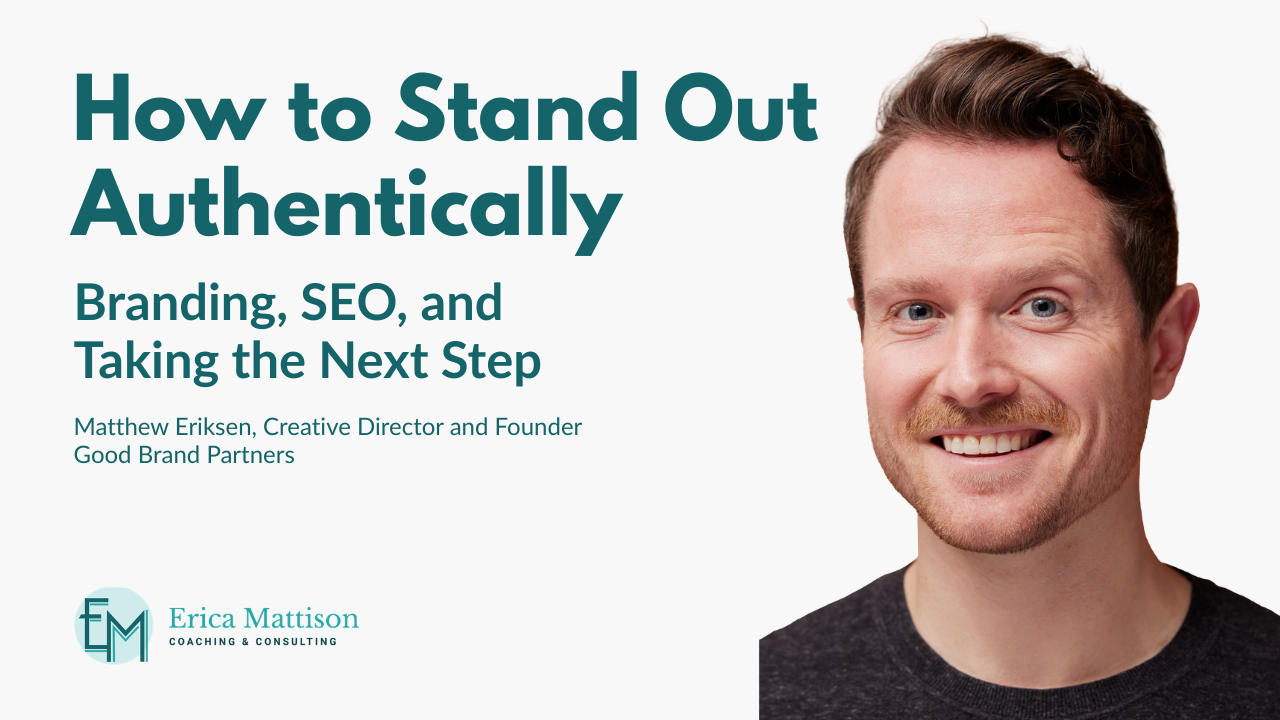
Standing out in a crowded market does not require making your business appear larger or more conventional than it is. Trying to look like everyone else can make it harder for the people you are best positioned to serve to recognize what makes your work distinctive.
Authentic branding begins with clarity about who you are, what you offer, who you want to serve, and how you want people to experience your business.
In this episode of the Conversations with Erica podcast, I speak with Matthew Eriksen, Creative Director and founder of Good Brand Partners, about authentic branding, search engine optimization, intentional networking, asking for help, and taking action before every step is mapped out.
Matthew helps independent business owners create clear, confident, and cohesive brand experiences. Our conversation explores how to communicate what makes your business different without trying to become someone you are not.
Why Authentic Branding Helps Your Business Stand Out
Many businesses begin a branding project because they want to differentiate themselves. Somewhere in the process, however, they start comparing themselves to competitors and choosing similar language, imagery, colors, and ways of describing their services.
The result may look professional, but it does not necessarily feel distinctive.
Matthew describes one common branding mistake as creating “smoke and mirrors.” A solo business owner might use “we” because they believe it will make the company seem larger. A creative, personable organization might adopt formal language because that is what it believes professionalism requires.
These choices can create distance between a business and the people it hopes to reach. Some clients specifically want an individual, personalized experience. Others want to work with someone whose values, personality, and communication style resonate with them.
This matters even more as AI-generated content becomes common. Your perspective, experience, values, and way of communicating are part of what make your work recognizable.
Your Brand Is More Than a Logo
Logos, colors, fonts, photography, and website design matter, but they are only part of the brand experience.
Your brand also includes:
- Your messaging and positioning
- Your website and customer journey
- Your systems and communication
- The expectations you create for prospective clients
A visually strong brand cannot compensate for unclear messaging. A well-designed website will not support your goals if visitors cannot understand what you offer, whom you help, or how to begin.
A business owner may think they need a new logo when the real issue is unclear messaging. An organization may believe it needs an entirely new website when the site functions well but no longer reflects its identity.
Before investing in a solution, assess what is working, where people become confused, what clients value, and what feels out of alignment. This can help you solve the most important problem rather than simply the most visible one.
How SEO Supports Your Brand Positioning
Search engine optimization, or SEO, improves the likelihood that people will find your website when searching for relevant information, services, or solutions.
Effective SEO is not simply about attracting more traffic. It is about helping the right people find you.
Matthew shares an example from his own business. A page optimized for “logo design” might attract people seeking an inexpensive, standalone logo. That does not accurately represent the comprehensive brand strategy and design packages Good Brand Partners provides.
A phrase such as “brand design package” better reflects both the scope of the service and the clients the agency wants to reach. The language you use influences how people discover your business and what they expect when they arrive.
Why Original Website Content Still Matters
Although SEO can feel technical, Matthew offers a straightforward recommendation: publish useful, original content that answers the questions your audience is already asking.
A strong service page should help prospective clients understand:
- Who you are and what you do
- Who the service is designed for
- What is included and how the process works
- What the timing and investment may be
- How to take the next step
This is often the same information you would provide during an introductory conversation. Publishing it clearly helps visitors determine whether the service is relevant while giving search engines useful information about your expertise.
Generic content may fill a page, but your examples, observations, stories, and perspective are what make it valuable and distinct.
Approach Business Networking With an Intention
Relationships played an important role in the growth of Good Brand Partners. Matthew’s early clients came through connections from his previous work, and in-person networking continues to support his business.
Networking can feel overwhelming when the goal is simply to “meet people.” A more useful approach is to enter an event with a realistic intention. You might aim to meet two potential collaborators, reconnect with a former colleague, or have one meaningful conversation.
You also do not have to attend alone. Bringing a friend or colleague can provide a familiar point of connection while you become oriented to the space.
Matthew also recommends asking event organizers for assistance. When you clearly explain the kind of person you hope to meet, they may be able to make a relevant introduction. Being specific about what you need makes it easier for others to support you.
Take the First Step Before You Know the Entire Plan
Good Brand Partners began after Matthew was laid off from a position in live entertainment during the pandemic. He did not begin with a complete vision for an agency, office, team, or long-term strategy. He began by helping a friend create a website.
Each project gave him information about the clients he enjoyed serving, the services he wanted to provide, and the work that was not aligned with the business he hoped to build.
Planning has value, but it can also become a way of delaying progress. You may convince yourself that you need more information or confidence before beginning. Often, taking one meaningful step creates the information you need to identify the next one.
You do not need to know the seventh step before taking the first.
Growing a Business Means Growing as a Leader
As demand for Matthew’s work increased, he reached a point where aligned inquiries exceeded the time available to complete them. That led him to hire his first full-time employee and enter a new stage of leadership.
In our conversation, Matthew reflects on the responsibility involved in supporting another person’s development, workflow, compensation, and workplace experience. He is thinking intentionally about onboarding, communication, feedback, boundaries, and the employee’s first 30, 60, and 90 days.
Leadership does not require pretending to have every answer. You can provide direction while acknowledging that you are learning, remain open to feedback, and make thoughtful decisions without guarantees.
Listen to the Full Episode
This conversation is for entrepreneurs, aspiring business owners, leaders, and professionals who want to communicate their value more clearly and move forward without waiting for a perfect plan.
Matthew and I discuss:
- Authentic branding and business differentiation
- SEO and original website content
- Intentional networking and asking for help
- Entrepreneurship, hiring, and leadership
- Taking action before the entire path is clear
About Matthew Eriksen
Matthew Eriksen is a brand designer and sustainable business advocate. As Creative Director and founder of Good Brand Partners, he helps independent business owners create clear, confident, and cohesive brand experiences.
Guided by The Brand Evolution™ Method, Matthew takes a holistic approach so that branding and business systems work together. His services include brand identity, logo design, marketing collateral, copywriting, website development, HoneyBook consulting, and customer journey mapping.
Learn more about Good Brand Partners ➔
When You Are Ready to Take the Next Step
You may not need a complete reinvention. You may need greater clarity about what is working, what feels out of alignment, and which next step would create meaningful progress.
In my work as an executive coach, I support professionals, leaders, and business owners as they clarify their direction, strengthen their leadership, and make intentional decisions about what comes next.